T+973
Pushing the boundaries of the 1kb intros category again, winning the Demosplash 2026 competition at Carnegie Mellon University with an impossible project
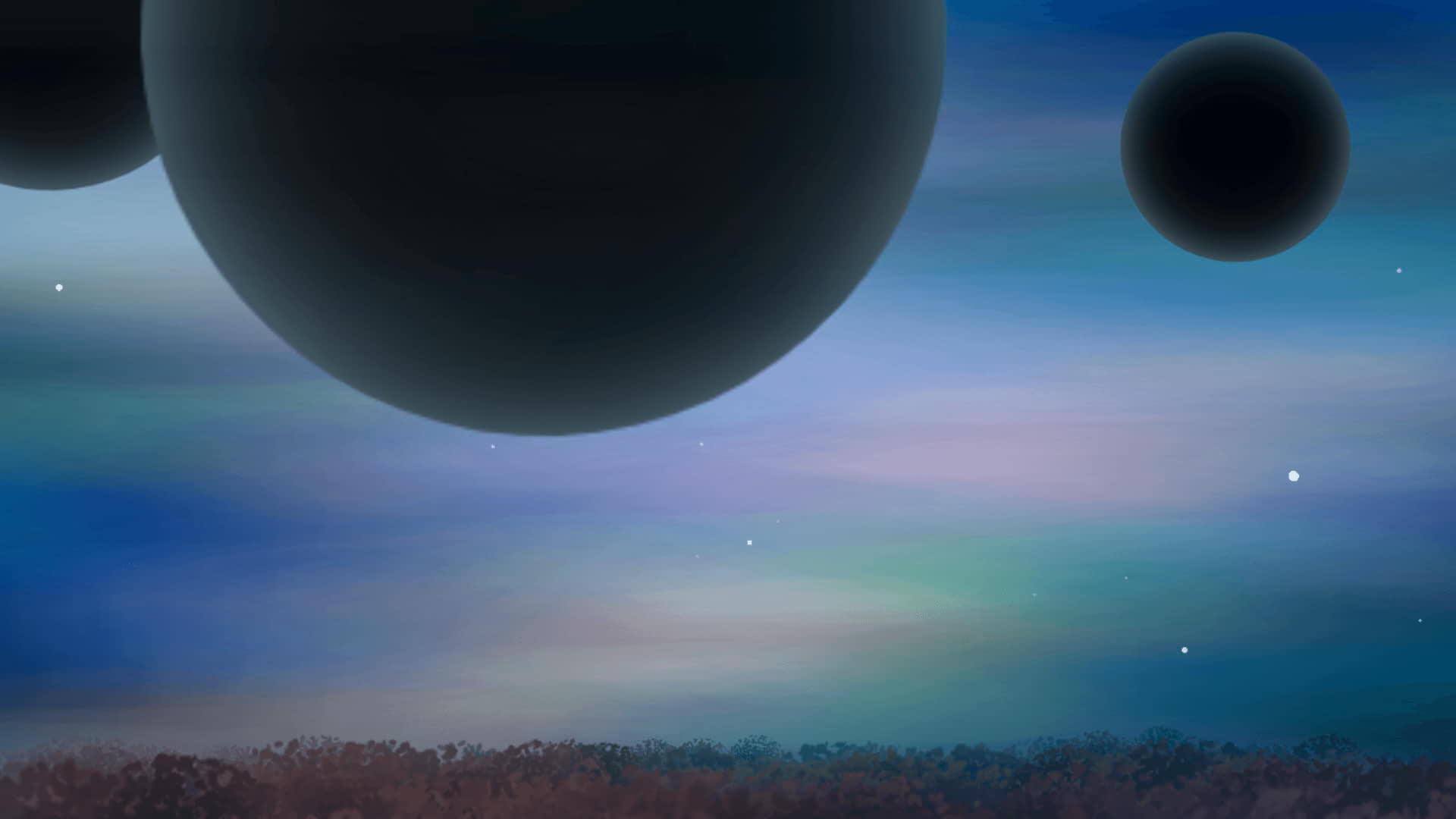
Demosplah has been running at CMU for 16 years, and been receiving increasing attention and quality 1kb intros lately so it was the natural venue to join after the demise of the 1kb category from the Assembly roster.
This impossible project took 973 days to land. Given the space theme, it seemed fitting to use space project nomenclature: T+973
How it started, T+0
After winning Assembly 2023 with EXPI, I was so excited about the next competitions as pestis and I had just unlocked a ton of potential with our custom watcher and minifier targetting Brotli.
Came March 2024, my usual time for more concrete exploration and prototypes for the summer compos, and I stumbled upon a music video for Pulling Focus by Snakes of Russia.
It was eerie, and I couldn't help thinking this would make an incredible 4kb intro, but would be impossible for a 1kb.
Yet; there was something.
I worked on first protoypes. My initial idea was to do a parallax scroller with a single layer for the sky like Clouds for 256B.HTM round 2 on steroids, and a few layers of fractal trees.
The sky looked alright, but not good enough. The trees were too geometric/predictable. And the whole looked too flat, too simple and deja vu. I tried and tried, but ultimately ran out and let summer 2024 slip.
Health hiatus, T+334-950
February 24th, 2025, life took a scary turn for the family, with months in hospitals, daily visits, short nights, more medical scares til this day. This whole journey into a new life has just begun.
When things looked more positive in June 2025, I managed to escape reality by spending some nights on ELLIPSIS, breaking the record of sinus dots curve on Atari STf with a banging tune by Dubmood. Doing one of those was on my bucket list since the the 90s
And again in May 2026, one year later, where I spent more nights on MAXIMUM JOKER to break the record of 4x4 rotozoom with 103x68 chunks (the 104x69 version is still waiting to be confirmed on real hardware that is scattered around the house since then) on Atari STe with an absolute hit by Hoffman playing at 25kHz for over 3mins. Some might say it is almost like a full pop song.
Apart from these two mad escapes towards my demoscene roots, I did not have time or energy for much else.
This impossible project stayed in the back of my head. Over time, I leaned towards a different approach.
Coming back, T+950-973
November 2026, as things are more calm at home, I return to the project after Halloween and hearing that Demosplash accepts Javascript entries.
The approach I kept coming back to during the hiatus was simple.
Visual aka the billboards soup
The only way to get a lively scene, with depth and details, was to have many layers. And the simplest, most compact, way to achieve this is to have a soup of billboards with the camera panning around like a car driving along.
The first prototype of this idea was very convincing, so I went on.
The background of the canvas should serve as vignetting and hint at the sunset, using a radial gradient from pink to black.
The trees, were the most challenging. To get a natural look with little repetition and a compact code, I thought of creating a billboard that reprensents a "ball" of folliage with random leaves shaded based on the angle and radius. I'd use randome size and base angle for each "tree top" in the forest, and rotate them with the wind to make everything come to life.
The sky is made of layers of haze, horizontally stretched splats of colors. Various shades of blue to white, at different opacity. Using different layers allows to make the clouds more volumetric; have a real depth that progressively hide the most distant trees as a fog and add some texture to the floating spheres.
The floating spheres were simpler. A simple disc with exponential back off for the light comming from the sunset behind them.
And finally the stars are just a white disc.
Here they are. The 4 unique billboards that make up T+973
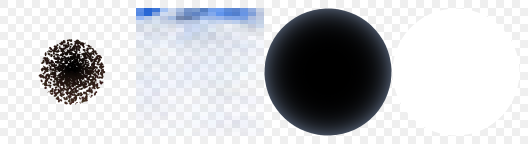
To make the code more compact, the creation code of these 4 billboards follow the same pattern and they are all made up of ellipse splats of hsl or hsla colors.
// variable used to splat the billboard in the render loop
_haze =
// create and a size the canvas
_C =
  document.createElement`canvas`,
_X=_C.getContext`2d`,
_C.width = 16,
_C.height = _C.width * 6;
// Loop through most/all pixels, and fill the ellipse
for (_i = 1536; --_i; _X.fill())
  // begin the current ellipse
  _X.beginPath(
    // pick its color
    // eg. some progressively transparent black -> blue -> white for the haze
    //     or shades of orange/red getting darker based on the radius and angle for the foliage
    _X.fillStyle = `hsla(218,100%,${_R() * 128}%,${_R()*4 / _i}`
  ),
  // place the current ellipse
  // e.g. just covering the billboard with narrow ones
  _X.ellipse(_i % 16, _i / 16, 2, _R()*4, _i, 0, 7);
Recipe of that soup
There are 2048 billboards, to match the number of samples in the ScriptProcessor node used for the sound synthesis and the usual audio+visual render loop.
Every 64th billboard is either a layer of haze or a star.
Four special positions among the 2048 billboards are reserved for the payload that drops at the end of the intro, and the 3 floating spheres.
All the other ones are random trees, and these are the only one panning along to simulate the car driving out to see the floating spheres entereing the atmosphere.
The flock of birds, and the payload uses the billboard of the foliage for their irregular shape.
Morning and evening skies
Showing a work in progress to kanel , he suggested to adjust the color of the sky, or even to follow the clock.
This was not easy to squeeze into 1kb but oh so worth it! Thank you sir. I really like how the sky, and trees look under different lights, depending when you watch T+973
To make sure that every element, shift with time, I used the CSS filter:hue-rotate(...) on the canvas
_C.style = `opacity:${(96 - _t) * 4};position:fixed;inset:0;width:100%;background:radial-gradient(#FCC,#000);filter:hue-rotate(${36 * _M.sin(new Date*88/864e6)}deg`
The opacity:${(96 - _t) * 4} does the fast opacity fade out on the final explosion
The ${36 * _M.sin(new Date*88/864e6)}deg hue rotate, swings 36 degrees warmer/colder based on the current time, and swings roughly 3x per day to have more chances to see the whole spectrum during one's normal day.
Camera work
The handheld camera look, was very important to seal the mood and narative. Luckily it rather simple;
_M.sin(_t / 7) ** 5 * 160 // for the Z focus changes
//
_M.sin(_t * 3) * 4 // for the X swing
_M.cos(_t / 7) ** 5 * 128 // for the X panning
//
16 * _M.min(_t, 24) // for the initial Y panning
_M.sin(_t * 4) * 4 // for the Y swing
Using **5 makes the changes accelerate. Also the changes of Z focus and X panning are synched to reveal different parts of the scene toghether as if the person in the back of the car moves the camera around when something happens.
Epic sound
Audio is not my strong suite, but I learnt a few tricks over the years.
The sin(a + sin(b) * c) formula is quite magic and allows to bring many frequencies, or even produce some noise. This oscillator is used with a sinus envelope for the lead horn and as is for the bass notes.
// _t = the time in seconds
// _P = the part/scene index
// each part/scene last 24 seconds
//
// the [`0022....`][_P]] selects the volume of the instrument in that part
//
// lead horn
[`0022`[_P]]*_M.sin((_a = [[1837,2752,2452,2184,,,,,2184,2452,2752,3275][_t/1.5&15]]*_t)+_M.sin(_a)) *_M.sin(_t/1.5*_M.PI)
// bass
+ [`0222`[_P]]* _M.sin((_a = [1837,2752,2452,2184,,,,,2184,2452,2752,3275][_t/3&3] * _t / 2) + _M.sin(_a)) / 2
For engine rumble, to hint at a car driving around to watch the floating spheres, uses an the same formula, simply accumulating a fraction of the Z focus point. I should rumble at a different speed, but that worked well enough. Also, I wish I could do away with this accumulator, but things get clicky.
// engine rumble: :\ gotta to increment another var to avoid clicks
+ _M.sin((_a = _J += 2 / _F) + _M.sin(_a)) //8
This is all mixed with a ~ half a second reverb at 75%
// reverb
[_M[_I%24520]] * .75
And finally we add the big Boooom using a botched bass drum which turned out to work great.
// booom
[`07707`[_P]] * _M.sin(452 * (_t % 24) ** .75) / (8 + (_t % 24) ** .5)
Custom minifier
For EXPI, we did a custom minifier mixing my watcher, packer, server thing and a Javascript port of pestis' Paketic doing Diversified Late Acceptance Search (DLAS) of better and better set of identifiers, plus a few custom rules specific to Brotli.
I forked the custom minifier, and went a bit side ways: Moving away from DLAS and a determinsitc RNG for Math.random() and several workers going round robin to mutate the identifiers and white space insertion sites and kick back to the local or global best set after N or M bad moves.
Not very scientific, but it got me there.
The dreaded AI question
The question burning on everyone's lips is whether I used AI to make T+973.
No, I did not use AI to make T+973
One thing I did try is to use AI to produce a Brotli parser to get their size in bits rather than bytes for the custom minifier, but as you can imagine that did not help one bit given my "creative approach" using Math.random() and a simple local or global kick.
So there you have the fully honest answer.
Source code
Here's the full source code of the compatible version, that contains some commented dead code, and /* debug */ statements that you can activate by pressing ENTER, and that are treated as line comments in the custom minifier.
It's messy, and that's OK.
You can see how I tried to get some kind of "car/window frame" but I never quite got the right amount of blur, resolution, and handheld camera movement and prefered to spend those bytes on adding a flock of birds taking off, and a few stars.
As for the size, the compatible/debug vesion of T+973 weighs 8,926 bytes including debug extras and comments. It minifies down to 2,384 bytes, and packs down to 1023 bytes.
<center style="font:2vh/96vh monospace"id=_W>+<script>
/* debug */   _introText = document.createElement(`div`);
/* debug */ _introText.innerHTML = `<b style="font:900 3em/1 monospace">T+973</b>\na 1024 bytes JavaScript demo\nby <b>p01/ribbon</b> for <b>Demosplash 2026</b>\n\n<b>973 days</b> to materialize this impossible project\n\n\n\n<b>Click to start</b>`;
/* debug */   _introText.style = `position: fixed; inset: 0; width: 100%; text-align: center; font: 2vh/1.5 monospace; top: auto; bottom: 44vh; white-space: pre-line`;
/* debug */   _W.parentNode.append(_introText);
  onclick = _g => {
    /* debug */ _introText.remove(),
  _M = Math,
  _R = _g => _M.sin(_S++) ** 2 * 1536 % 1,
  _A = new AudioContext,
    _g = _A.createScriptProcessor(2048, onclick = _J =_I = _V = _t  = _S = 0, 1),
//  _D = (_s, _h, _i) => (_C = document.createElement(`canvas`;, _C.width = ;s, _C.height; _i(_C.getContext(`2d`)), _C),
  _foliage = _C = document.createElement`canvas`, _X=_C.getContext`2d`, _C.width = 160, _C.height = _C.width;
  // _D(160, 160, _g => {
    for (_i = 1536; --_i; _X.fill())
      _X.beginPath(_X.fillStyle = `hsl(${_i % 36},36%,${_M.sin(_a = _R() * 6.3) * 4 + _i / 100}%`),
      _X.ellipse(80 + _i / 24 * _M.cos(_a), 80 + _i / 24 * _M.sin(_a), 2, _R() * 4, _i, 0, 7);
//    }
//  ),
  _haze = _C = document.createElement`canvas`, _X=_C.getContext`2d`, _C.width = 16, _C.height = _C.width * 6;
  // _D(24, 64, _X => {
    for (_i = 1536; --_i; _X.fill())
//      _X.beginPath(_X.fillStyle = `hsla(${218 + 36 * _M.sin(Date.now()/432e5*_M.PI)},100%,${_R() * 100}%,${_R()*8 / _i}`),
      _X.beginPath(_X.fillStyle = `hsla(218,100%,${_R() * 128}%,${_R()*4 / _i}`),
      _X.ellipse(_i % 16, _i / 16, 2, _R()*4, _i, 0, 7);
//    }
  // ),
  _sphere = _C = document.createElement`canvas`, _X=_C.getContext`2d`, _C.width = 256, _C.height = _C.width;
  // _D(256, 256, _X => {
    for (_i = 128; --_i; _X.fill())
      _X.beginPath(_X.fillStyle = `hsl(218,16%,${(_i / 64) ** 5}%`),
      _X.ellipse(128, 128, _i, _i, _i, 0, 7);
 //   }
  // ),
  _star = _C = document.createElement`canvas`, _X=_C.getContext`2d`, _C.width = 256, _C.height = _C.width;
  // _D(256, 256, _X => {
   for (_i = 128; --_i; _X.fill())
      _X.beginPath(_X.fillStyle = `hsl(218,16%,100%`),
      _X.ellipse(128, 128, _i, _i, _i, 0, 7);
 //   }
 //   // ),
//  _carFrame = _C = document.createElement`canvas`, _X=_C.getContext`2d`, _C.width = _C,height = 256;
//    for (_i = 128; --_i; _X.stroke())
//       _X.beginPath(),
//       _X.ellipse(128, 128+16, 32 + _i, 32, _i, 0, 7);
//  //   }
// //  _X.fillRect(0,0,96,96);
//   //_X.clearRect(48-8,42,18,12);
    _C = document.createElement`canvas`, _X=_C.getContext`2d`, _C.width = 1280,
  _g.connect(_A.destination),
  _g.onaudioprocess = _g => {
    /* debug */ debug = [];
    for (
    _g = _g.outputBuffer.getChannelData( _i = _S = 0,
    _W.append(_C),
    _W.firstChild.data = `RIBBON 2026`,
    // ;
    _P = _t / 24 & 7,
    _F = 600 - _M.sin(_t / 7) ** 5 * 160,
   _C.height = 720,
   _C.style = `opacity:${(96 - _t) * 4};position:fixed;inset:0;width:100%;background:radial-gradient(#FCC,#000);filter:hue-rotate(${36 * _M.sin(new Date*88/864e6)}deg`
   /* debug */ ,_C.style.cssText += `;outline:9in solid #000`
   //    _O = 2 - _M.cos(_t/7);
  ); _i < 2048; _i++)
      _a = 0,
      _z = 350 - _i / 6,
      _s = 1,
//       _i > 2046 ? (
// // 🚗
// _x =         _y = 0,
//         _T = _carFrame
//       ) :
      (_y = _i - 1837) == (_y & 3) ? (
        // ⚫
//      _s > -1 && _s < 3 ? (
        _x = [0, 54, -24, 0][_y] * _M.abs(44 - _t) ** .5,
        _s = [1, _P>1&&100, _P>1&&100, 100][_y],//_k ? 100 * (_k > 2 | _P > 1) : 1
        _T = _y ? _sphere : _foliage,
        _z = [100, 350, 218, 100][_y],
        _y = _y ? [0, -196, -160, -70][_y] - _M.max(0, 48 - _t) ** 2 / 9 : _M.abs(_t - 70) * (_t - 70) / 12 - 24
        // _T = [_foliage, _sphere, _sphere, _sphere][_s],
      // ) : _i == 1337 ? (
      //   _x = 0,
      //   _y = (_t - 74) * _M.abs(_t - 74) / 7 - 32,
      //   // debug.push(`debris at ${_x.toFixed(2)}, ${_y.toFixed(2)}`),
      //   _s = 1
      ) : (_i & -32) == 1056 ? (
//      ) : (_i / 32 | 0) == 33 ? (
        // 🕊️
        _x = (88 - _t) * 8 * _M.sin(_i), //64 + (88 - _t) * (_R() * 2 + 8),
        _y =  (88 - _t) * _R() * 4 + 44 + _M.sin(_i * 2 + _t)//,//, //8 + _z / 7 + _h / 2 + _M.cos(_x / 24) * _M.cos(_z / 24) * 8,
        //_z += _t / 8,
//        _s = 1
        //_x -= _t * 7 + _i /32//,
//          _a = _R() * 6.3 + _M.cos(_s + _t / 2)*16/_y // * _F / 16 / _s
      ) : _i % 32 ? (//_i % 64 - 9 ? (
        // 🌳
        _x = _R() * 4 * _z,
        _s = 32 + _R() * 96,
        _y = 8 + _z / 7 + _s / 2 + _M.sin(_x / 24) * _M.sin(_z / 24) * 8,
        _T = _foliage,
        _x += _t * 8,
        _a = _R() * 6.3 + 16 * _M.sin(_s + _t / 2) / _y // * _F / 16 / _s
      ) : _i & 64 ? (
        // ✨
        _x = _i, // * 4,
        _y = 12 -  _R() * 96,
        _T = _star//,
//        _s = 1
      ) : (
        //  ☁️
        _x = _R() *_z / 4,
        _y = 4, // + _z / 7,
        _T = _haze,
        //_a=_z%.75,
        _s = _z * 4//,
//        _h = _s / 2
        ),
//        _h=_s,
//      _F / _z = _F / _z,
      _X.setTransform(
        _M.cos(_a) * _F / _z,
        _M.sin(_a) * _F / _z,
        -_M.sin(_a) * _F / _z,
        _M.cos(_a) * _F / _z,
        480 + ((_x /_z + 2) % 4 - 2) * _F + _M.sin(_t * 3) * 4 + _M.cos(_t / 7) ** 5 * 128,
//        480 + ((_x / _z + 2) % 4 - 2) * _F + _M.sin(_t * 3) * 4 + _M.cos(_t / 7) ** 5 * 128,
//        _F * 3 / 5  + (_y + _M.max(24- _t,0)) * _F / _z + _M.sin(_t * 4) * 4
        //_F / 5 +
        _F / 5 + 16 * _M.min(_t, 24) + _y * _F / _z + _M.sin(_t * 4) * 4

      ),
      _X.drawImage(_T, -_s / 2, -_s / 2, _s, _s),
      /* debug */ (_i == 2047 ?  debug.push(`_a = ${_a.toFixed(2)}, _F/_z = ${_F/_z}`) : 0),
//      _u = (_t += 1 / _A.sampleRate) % 24,
     // _V = (_O * _M.cos(_a  * 720) + 1.5 )/ 32 ;
      //_k = _M.sin(_t/1.5*_M.PI),// *(_t/1.5%8<5);
         _t += 1 / _A.sampleRate,      //      _p = 4 * _z,
      _g[_i] =
      // booom
     [`07707`[_P]] * _M.sin(452 * (_t % 24) ** .75) / (8 + (_t % 24) ** .5)
      // [` 99 9`[_P]] * _M.sin(452 * (_t / 24 % 1) ** 31) / (8 + (_t % 24) ** .75) +/// (1 + (_t / 24 % 1) ** 5 * 16) +
+      (_M[_I%24520] =
        // reverb
        [_M[_I%24520]] * .75
//        +        _M.sin((_a = [[1837,2752,2452,2184,,,,,2184,2452,2752,3275][_t/3&3]]*_t/2)+_M.sin(_a)) / 16
        // lead horn
        +(
          [`0022`[_P]]*_M.sin((_a = [[1837,2752,2452,2184,,,,,2184,2452,2752,3275][_t/1.5&15]]*_t)+_M.sin(_a)) *_M.sin(_t/1.5*_M.PI)
        //        + _I++ % 2
            // engine rumble: :\ gotta to increment another var to avoid clicks
            + _M.sin((_a = _J += 2 / _F) + _M.sin(_a)) //8
            // wind // swinging noise w. dampening "low pass"
            + (_V = _V *.97 + 16 * _M.sin(_I++ ** 5) / _F)/// (32+8*_M.cos(_t / 7)))
            // bass
            + [`0222`[_P]]* _M.sin((_a = [1837,2752,2452,2184,,,,,2184,2452,2752,3275][_t/3&3] * _t / 2) + _M.sin(_a)) / 2
        ) / 8
      )
//    }
    // _X.setTransform(1,0,0,1,0,0);
    // _X.fillStyle = `#fff`;
    // _X.fillText(new Date().toLocaleString(), 8, 16);
    /* debug */ // camera frame/ guide
    /* debug */; _X.resetTransform(),_X.fillStyle=`#fff${window.showDebug?'f':'0'}`,
    /* debug */ _X.fillRect(0, 720/3,1280,.1),
    /* debug */ _X.fillRect(0, 720/2,1280,.2),
    /* debug */ _X.fillRect(0, 720*2/3,1280,.1),
    /* debug */ _X.fillRect(1280/3,0,.1,720),
    /* debug */ _X.fillRect(1280/2,0,.2,720),
    /* debug */ _X.fillRect(1280*2/3,0,.1,720)
    /* debug */; if (window.paused) _t -= 2048 / _A.sampleRate;
    /* debug */ _X.resetTransform();
    /* debug */ debug.unshift(`part = ${_P}`);
    /* debug */ debug.unshift(`_J = ${_J}`);
    /* debug */ debug.unshift(`time = ${_t.toFixed(2)}s`);
    /* debug */ debug.push(`_z = ${_z.toFixed(2)}`);
    /* debug */ debug.push(`_F/_z = ${_F/_z}`);
    /* debug */ _X.font = `900 16px monospace`;
    /* debug */ _X.fillStyle = `#fff${window.showDebug?'8':'0'}`;
   /* debug */ debug.forEach((d,i)=>_X.fillText(d,8,32+i*16));
;  }
  /* debug */ onkeyup = e => {
  /* debug */   let handled = true;
  /* debug */   const intensity = e.shiftKey ? 24 : 1;
  /* debug */   if (e.code === `ArrowLeft`) {
  /* debug */     _t -= intensity;
  /* debug */   } else if (e.code === `ArrowRight`) {
  /* debug */     _t += intensity;
  /* debug */   } else if (e.code === `Space`) {
  /* debug */     window.paused = !window.paused;
  /* debug */   } else if (e.code === `Enter`) {
  /* debug */     window.showDebug = !window.showDebug;
  /* debug */   } else {
  /* debug */     handled = false;
  /* debug */     console.log(e);
  /* debug */   }
  /* debug */   if (handled) { e.preventDefault(); }
  /* debug */ }
}
</script>
Feedback and additional links
I am really happy with T+973, and I believe it does push the 1kb category a bit.
That said it is hard to take some distance and I would love to get more feedback and comments on T+973 on Pouet.net to know where to push more next time.
- HD Youtube capture
- Full archive submitted at the Demosplash 2026
- T+973 on Pouet.net the demoscene portal.
Thank you so much.
Hope you enjoyed T+973, and don't hesitate to reach out.